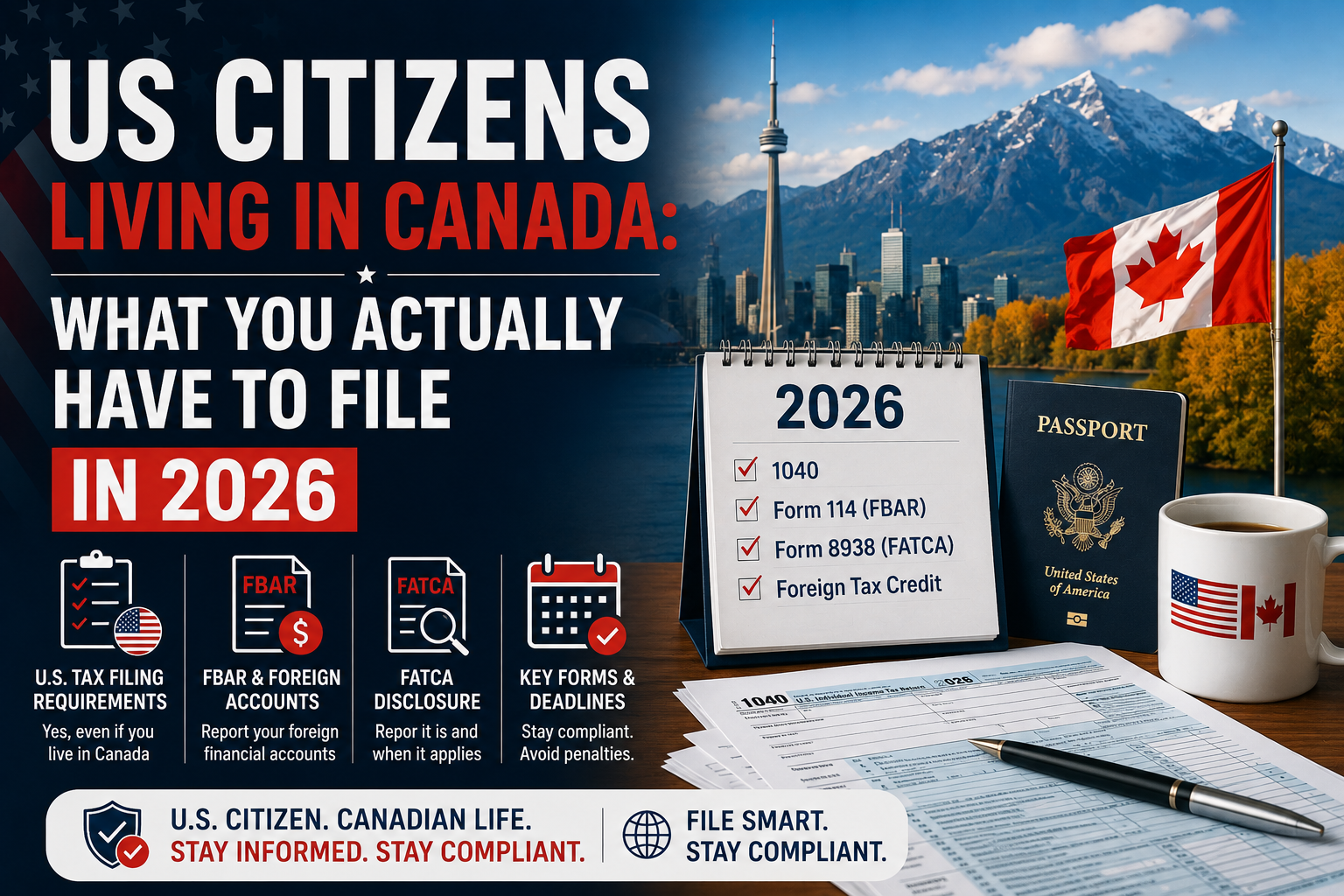
You can be fully compliant with the CRA and still be years behind with the IRS. Here is what Americans in Canada are actually required to file — and the three Canadian accounts that cause the most trouble.
THE SHORT ANSWER Yes — the United States taxes its citizens and green card holders on worldwide income regardless of where they live. If you are an American living in Canada, you must file a US federal return every year in addition to your Canadian return, even if you owe nothing. You will also likely need to file an FBAR if your Canadian accounts together exceeded US$10,000 at any point in the year. Because of the Canada-US tax treaty and foreign tax credits, most people in this position owe little or no US tax — but the filing obligation is separate from the tax obligation, and the penalties attach to not filing, not to not paying.
A conversation we have regularly in our Mississauga office goes something like this. Someone was born in Chicago, moved to Canada at four years old, has never worked a day in the United States, files their Canadian return on time every year, and has just been told by their bank that they need to complete a form about US tax residency. They are, in the eyes of the IRS, a US person with an unfiled return for every year they have been an adult. This catches people constantly, and it is not a sign that anyone did anything wrong. The rule is genuinely counterintuitive, and until banks began reporting under information-sharing agreements, most people in this position had no reason to discover it.
Why you still have to file
Almost every country taxes based on residency. The United States is one of the very few that taxes based on citizenship.
That means the obligation follows the passport, not the address. It applies whether you left the US as an adult, as a child, or were simply born there to Canadian parents and returned home weeks later. It applies to green card holders who have moved to Canada permanently but never formally abandoned their status — a group that is frequently unaware the card carries continuing tax obligations.
Filing Canadian returns does not satisfy it. Paying Canadian tax does not satisfy it. The two systems run in parallel, and the treaty between them exists to prevent double taxation, not to remove the duty to file.
What you actually have to file
The specific forms depend on your circumstances, but most Americans in Canada are dealing with some combination of the following:
Filing
Who It Applies To
Threshold
Deadline
Form 1040
Every US citizen and green card holder
Standard filing thresholds by status
June 15 abroad; Oct 15 extended
FBAR (FinCEN 114)
Anyone with foreign financial accounts
US$10,000 aggregate, any point in year
Apr 15; automatic ext. to Oct 15
Form 8938 (FATCA)
Higher-value foreign assets
Higher thresholds; varies by status
With the 1040
Form 8621 (PFIC)
Holders of Canadian mutual funds or ETFs
Generally any holding
With the 1040
Forms 3520 / 3520-A
Certain foreign trusts — may include TFSAs and RESPs
Varies
With or alongside the 1040
Form 5471
Shareholders of a Canadian corporation
Ownership thresholds apply
With the 1040
The FBAR catches the largest number of people. It counts the combined maximum balance of every Canadian account you hold or have signing authority over — chequing, savings, TFSA, RRSP, RESP, and often corporate accounts you sign on. A single day above the threshold triggers it. Many people cross it without noticing, particularly in a year they received a bonus, sold a car, or moved money before a house purchase.
Note the deadline difference: Americans abroad receive an automatic extension to June 15 for the return itself, but any US tax owing is still calculated from April 15. For most people in Canada that distinction is academic, because there is nothing owing.
Will you actually pay tax twice?
Usually not. This is the part that causes the most unnecessary anxiety, and it is worth being clear about.
Two mechanisms prevent double taxation. The foreign earned income exclusion lets you exclude a substantial amount of foreign employment income — the limit is indexed annually and currently sits comfortably above $130,000 USD. The foreign tax credit lets you credit Canadian tax already paid against your US liability.
Because Canadian personal tax rates generally exceed US rates at comparable income levels, the credit alone eliminates the US liability for most people. The Canada-US tax treaty resolves most remaining conflicts.
Which mechanism suits you is a planning decision rather than a formality. The exclusion and the credit interact differently with the child tax credit, with self-employment income, and with future years, and choosing the wrong one can cost real money or lock you into a treatment that is awkward to change later.
THE DISTINCTION THAT MATTERS MOSTThe penalties in this system attach to failing to file, not to failing to pay. Someone who owes nothing and files nothing is exposed; someone who owes nothing and files on time is fine. That is why people who have never owed a dollar of US tax can still face a serious problem — and why the fix is almost always simpler than they fear.
The three Canadian accounts that cause the most trouble
This is where cross-border filing stops being administrative and starts being expensive. Three completely ordinary Canadian accounts are treated unfavourably by the US system.
1. Your TFSA
The Tax-Free Savings Account is not recognised as tax-free by the IRS. Income and gains inside it are generally taxable on your US return, and depending on how the account is structured it may be treated as a foreign trust, bringing additional reporting on Forms 3520 and 3520-A — filings that carry substantial penalties when missed.
The practical result is a tax-sheltered Canadian account that produces a US tax bill and a reporting burden. For many US persons in Canada, a TFSA is simply the wrong vehicle, and money is better directed elsewhere.
2. Your RESP
The Registered Education Savings Plan has a similar problem. The grant portion may be treated as taxable income to the subscriber for US purposes, and the plan may fall within the foreign trust reporting rules.
This one is particularly frustrating because parents open RESPs specifically to do the responsible thing, and discover years later that the account created an unreported filing obligation.
3. Canadian mutual funds and ETFs
This is the costliest of the three and the least known. Most Canadian mutual funds and ETFs are classified as passive foreign investment companies, or PFICs, under US rules.
PFIC treatment is punitive by design. It can apply the highest ordinary income rates to gains, add an interest charge for each year the holding was in place, and requires Form 8621 — often one per fund, per year. An investor holding six Canadian ETFs in a non-registered account may be looking at six separate forms annually, prepared under a regime built to discourage exactly that holding.
Worth stating plainly: this does not mean a US person in Canada cannot invest. It means the structure of the portfolio should be planned with the US side in mind from the start. US-domiciled ETFs, individual securities, and certain account types avoid the problem entirely.
What about your RRSP?
Good news here. Under the treaty, RRSPs and RRIFs receive tax deferral for US purposes, and the separate election form once required is no longer necessary. The accounts still need to be reported on the FBAR and potentially Form 8938, but the growth inside them is not taxed annually by the IRS. Of the registered accounts, the RRSP is the one that works properly across both systems.
Not sure which of these applies to you?AV CPA Professional Corp provides cross-border tax services for Americans living in Canada and Canadians with US income — led by a CPA holding the Advanced Diploma in International Taxation. We handle both sides of the border in one place. Book a confidential consultation at avcpaprofessionalcorp.com 2800 Skymark Avenue, Suite 303, Mississauga, ON L4W 5A6
What if you haven’t filed in years?
This is the most common situation we see, and the anxiety around it is almost always disproportionate to the actual difficulty of fixing it.
The IRS operates the Streamlined Foreign Offshore Procedures for taxpayers whose failure to file was non-wilful — meaning it resulted from genuinely not knowing rather than from deliberate avoidance. Someone who left the United States as a child and had no idea the obligation existed is the exact profile the programme was designed for.
Broadly, the process requires filing the most recent three years of returns, six years of FBARs, and a signed statement explaining the non-wilful nature of the failure. For qualifying taxpayers living outside the United States, the penalty structure under this programme is significantly more favourable than the alternative.
Two points matter. First, eligibility depends on coming forward before the IRS contacts you — once they have made contact, the programme is generally no longer available. Second, whether your circumstances qualify as non-wilful is a judgement call with real consequences, and it should be assessed by someone who works in this area rather than self-diagnosed.
THE ONE THING NOT TO DODo not quietly file the last few years and hope the earlier ones go unnoticed. Filing outside a formal programme without addressing the back years is a recognised approach that carries real risk, and it can complicate access to the streamlined procedures later. If you are behind, get advice before you file anything.
What to do next, in order
1. Confirm your status. If you were born in the US, hold a green card, or have a US parent, establish whether you are a US person for tax purposes before assuming either way.
2. Total your Canadian accounts. Take the highest balance each account reached during the year, add them together, and see whether the combined figure crossed US$10,000 at any point.
3. List your investments. Identify any Canadian mutual funds or ETFs, and any TFSA or RESP. These determine most of the complexity in your situation.
4. Do not file anything yet if you are behind. Get an assessment first — the order in which you approach back filings materially affects your options.
5. Plan the investment side going forward. Restructuring a portfolio to avoid PFIC treatment is straightforward once you know it is needed, and expensive once it has run for years.
Frequently asked questions
Do US citizens living in Canada have to file US taxes?
Yes. The United States taxes its citizens and green card holders on worldwide income regardless of residence, so you must file a US federal return annually in addition to your Canadian return — even if you owe no US tax. Filing Canadian returns does not satisfy the US obligation. Most Americans in Canada owe little or nothing because of foreign tax credits and the Canada-US treaty, but the filing requirement stands.
Is a TFSA taxable in the United States?
Generally yes. The IRS does not recognise the TFSA as tax-free, so income and gains inside it are typically taxable on your US return. Depending on how the account is structured it may also fall within the foreign trust rules, adding Form 3520 and 3520-A reporting with significant penalties for non-filing. For many US persons in Canada, a TFSA is the wrong savings vehicle.
What is an FBAR and do I need to file one?
The FBAR, FinCEN Form 114, reports foreign financial accounts to the US Treasury. You must file it if the combined maximum balance of all your non-US accounts exceeded US$10,000 at any point during the year — including chequing, savings, RRSP, TFSA, RESP, and accounts you have signing authority over. A single day above the threshold triggers the requirement, and it is filed separately from your tax return.
What happens if I haven’t filed US taxes in years?
If your failure to file was non-wilful, the IRS Streamlined Foreign Offshore Procedures allow you to catch up — broadly, three years of returns, six years of FBARs, and a certification of non-wilfulness — with a far more favourable penalty structure than the alternative. Eligibility generally requires coming forward before the IRS contacts you. Get advice before filing anything, because the sequence affects your options.
Are Canadian ETFs a problem for US taxpayers?
Usually, yes. Most Canadian mutual funds and ETFs are treated as passive foreign investment companies (PFICs), which carries punitive tax treatment and requires Form 8621 — often one form per fund per year. US persons in Canada can still invest, but the portfolio should be structured with US rules in mind. US-domiciled ETFs and individual securities avoid the issue.
Do I need a cross-border accountant, or can my regular CPA handle it?
Canadian and US filings each require their own expertise, and the interaction between them — treaty positions, foreign tax credits, PFIC elections, foreign trust reporting — is a specialised area. Many excellent Canadian CPAs do not prepare US returns, and many US preparers are unfamiliar with Canadian registered accounts. Working with one firm that handles both sides avoids gaps between two advisors who each assume the other covered something.
This article provides general information for US persons resident in Canada and is not tax or legal advice. US and Canadian tax rules change, thresholds are indexed annually, and the right approach depends entirely on your specific circumstances. Speak with a qualified cross-border tax professional before acting.
One firm. Both sides of the border. AV CPA Professional Corp serves Americans in Canada, Canadians with US income, and cross-border business owners across Mississauga, Toronto and the GTA — US and Canadian returns, FBAR and FATCA reporting, streamlined catch-up filings, and PFIC planning. Book your consultation at avcpaprofessionalcorp.com 2800 Skymark Avenue, Suite 303, Mississauga, ON L4W 5A6
Address: 320 Matheson Blvd W, Suite 211, Mississauga, ON L5R 0H2
Email: admin@avcpaprofessionalcorp.com
Phone: +1 289 218 6331
Work Time:
Mon - Fri: 9am - 6pm
AV CPA Professional Corp stands at the forefront of the accounting and tax industry, offering a comprehensive suite of services in accounting, tax, and finance to businesses throughout Canada and the US.